Powered by ScribeFire.
Monday, December 21, 2009
He trains India's poorest students for the IIT
Thursday, November 19, 2009
A different reason for this recession
Why are we in a recession? An NBER paper by Ravi Jagannathan, Mudit Kapoor, Ernst Schaumburg.
In quotes:
"Arguing against conventional wisdom about the causes of the recession, the authors say that the inability of existing financial and legal institutions to cope with the huge increase in the world’s labour supply in a very short time period, led to the recession."
This paper is available as PDF (741 K) or via email.
Powered by ScribeFire.
Tuesday, November 17, 2009
Monday, November 9, 2009
A 'green' entrepreneur's success story

Powered by ScribeFire.
Friday, November 6, 2009
Mickey Mouse in IIMA

Powered by ScribeFire.
Wednesday, November 4, 2009
Debate: Global Impact.. of Global Indians
What does the Galleon Scandal tell us about the impact made by Indians abroad? Click here for an interesting debate.

Powered by ScribeFire.
Wednesday, August 26, 2009
BS - Indian Slums - a Research
"Indian slums are incredibly productive.. (Read Full Article on Business Standard).

Powered by ScribeFire.
Monday, August 24, 2009
WSJ - Why Companies See Bright Prospects in Rural India

Powered by ScribeFire.
Sunday, August 23, 2009
ISB Talk - DEMYSTIFYING THE DRAGON

Powered by ScribeFire.
Sunday, July 5, 2009
How Individuals Could Help India's Infrastructure
By SUDIP BANDYOPADHYAY

The single largest problem facing India on its path towards economic glory is the lack of adequate infrastructure. Every aspect of infrastructure in our country is decades behind the developed world and even our Southeast Asian neighbors. The pace of infrastructure development in the Gulf region and in some African countries is probably better than that in India. Every area of our economic endeavors – be it agriculture, industry or services -- is suffering seriously due to the absence of adequate infrastructure support. There is a crying need for the government to take vital steps in this direction. Massive infrastructure spending at this stage will set in motion a huge virtuous economic chain reaction which would definitely benefit the overall economy significantly. Read full article...
Powered by ScribeFire.
Tuesday, June 2, 2009
Venture Capital in India - Sramana Mitra
Sramana Mitra's views on Venture Capital in India. Please click here to be taken to Sramana's website.
India is flushed with investment commitments from the giants of technology. Microsoft, Cisco, IBM, SAP, Intel, and AMD have each committed over a billion to further develop their India presence.
So have many of the leading venture capital firms from Silicon Valley. For the longest time, Valley VCs would only invest in their backyard. No more. India, China, Israel are fair game today. This month, Matrix Partners has announced a $150 Million India fund. Sequoia has acquired Westbridge Capital, an India focused fund that has been around for five years. Several other major VCs are playing the space – Kleiner Perkins, NEA, Norwest, Battery, Sierra, Canaan Partners.
Yahoo has started investing in Consumer Internet startups, the first of which was announced recently (Bharatmatrimony.com), playing the corporate venture capital game.
Together, the committed capital chasing India is abundant.
Business Week writes cover stories on how the new billion dollar companies will emerge from India. Some have, already. Infosys, Wipro, TCS. No doubt, the lure of India for VCs is legitimate. These new darlings of Wall Street were built without their money. They want to make sure the next wave is built with.
In today’s India, the commodity in short supply is good entrepreneurs. In VC parlance, fundable deals are few and far between. Why?
Historically, India has been the world’s back-office. Consequently, the skill-set that has developed in India is that of engineering management and coding. The specifications are provided by teams elsewhere. Elsewhere, the market studies get done. Indian managers do not understand global technology markets. They have hardly had opportunity to learn this aspect of business. Entrepreneurs try to position products without knowledge of the product marketing discipline.
The natural instinct for Indian entrepreneurs is to build outsourcing services companies. BPO. Software Development. Chip Design. Those ventures take less capital, and become revenue generating fast. None of the Operating Loss period of a pure play product company is necessary, and hence, venture capital is also unnecessary.
VCs typically do not like this business model. It has low entry barrier. But those who have invested in India in the last five years have also invested in this model and made money off it. It was the only thing that was available. It is, however, becoming less appealing, since those markets are also maturing, and behemoths start to rule.
The next stop for VCs, the most recent wave, has been Consumer Internet and Mobile offerings. India’s growing mass of connected consumer population is the target wallet. Travel, Matrimonials, Jobs, Games, Mobile Payments are all segments getting substantial capital infusion. This trend is likely to continue for the next 18 months. The engineering required in building these sites is marginal, marketing being the big differentiator.
But it will still not consume the available capital. Those who understand the subtleties of these dynamics have started diversifying their portfolios with Retail, Bio Tech, Real Estate. Sequoia’s Royal Orchid Hotels is a case in point. Oak Investment Partners has set up a $200 Million venture fund to focus on the retail boom in India. Veteran retail investor Jerry Gallagher visited India and was astounded by the revenue per square feet in the malls and stores. He came back and convinced his partners to commit capital.
Bio Tech has produced one of the flagship entrepreneurs for India, Kiran Majumdar-Shaw, who is now pulling her weight to drag the entire industry up. India has a better opportunity in this field for the same reason as Retail: domestic producer, domestic consumer. Tests can leverage a gene pool that is perhaps one of the most diverse and universal in the world. If Indian policy-makers can get their act together, then India could even lead a stem cell research effort that is so far faltering in the US. VCs would be delighted to play.
Real Estate, however, is a different animal. For the longest time, the old money in India had only one legitimate investment vehicle. That was buying properties. Indians know a lot more about Real Estate entrepreneurship than any other kind of entrepreneurship. There is a financial eco-system around Real Estate that works, and by and large, venture capital is unnecessary, even unwelcome. Private Equity investors, however, are playing this market.
Conspicuous by its absence in the above discussion is traditional technology venture investing, the game that VCs know best. The reason being, it is almost absent from the technology firmament of India.
Intriguing, but entirely logical. Technology innovation takes intense domain knowledge. Be it in software, hardware, chips or communications, the engineers capable of innovation of this nature are inside the multinationals, harvesting unthinkable salaries, enjoying unbound luxury and lifestyle with servants, chauffeurs, maids, nannies, and cooks coming out of their ears. A $200,000 salary in India effortlessly affords a grand lifestyle that even multi-millionaires in the US cannot dream of.
People become entrepreneurs for two reasons: either they have a chip on their shoulder, and have something to prove to themselves and to the world around them. Or, they want to afford a lifestyle that is substantially above their current means. India is banking on the motivation of the former category alone, to find its technology entrepreneurs.
The onus, I am afraid, comes back to Silicon Valley to come up with technology innovation, which Indian back-offices can then implement and scale.
Venture capitalists will continue to go on their eco-tourism trips to India, then return. In the words of Marcel Proust, The real voyage of discovery consists not in seeking new landscapes, but in having new eyes.
Powered by ScribeFire.

Saturday, May 30, 2009
India's Economy Grows 5.8%
By JACKIE RANGE and NEELABH CHATURVEDI
NEW DELHI -- India's economic expansion slowed in the most recent quarter, but the new government and invigorated capital markets prompted some economists to suggest that the country has weathered the worst of the global downturn.
Reuters A couple walk at the seafront in Mumbai May 11, 2009.
According to data out Friday, India's gross domestic product grew 5.8% on the year in the quarter ended March 31, down from 8.6% growth in the year-earlier period. The numbers come on the heels of increased government spending and a robust performance in several sectors, offsetting a manufacturing decline.
Friday's figures indicate that India has withstood the global downturn better than many nations with export-driven economies that are mired in recession or forecast to post scant growth for the year. Full Story.

Powered by ScribeFire.
Thursday, May 28, 2009
Monday, May 25, 2009
Moving from "Made in India" to "Made for India"
This is a pointer to the full article here by Devita Saraf.
Two years ago, I visited Shanghai on a business trip and went to the famous Yu-yuan gardens. Outside the tourist attraction, like every other in the world, were hoards of souvenir stores selling locally produced handicrafts. The beautiful wood and jade carvings, painted silk screens and other memorabilia had faces created on them. I thought they would be holy Chinese images, but on closer inspection they turned out to be portraits of Brad Pitt, Angelina Jolie, Tom Cruise and even George Bush. This would never happen in India. We have our own set of demigods in Bollywood actors and cricketers.
Devita Saraf, CEO of Vu Technologies and Executive Director of Zenith Computers The Maoist Revolution in China turned their cultural identity into a clean slate, which is the reason their dressing, tastes and aspirations are largely inspired by the western world. India, in contrast, has given a stubbornly tough time to McDonalds, KFC and others as they tried to gain a foothold in the Indian market unless they "Indianized" their menus. By this, I mean that the menu must be suited to the Indian budget and the Indian palette. At Indian weddings, we proudly flash Indian designers and traditional Indian wear, which is why few Western designers have been able to succeed with their formal range of clothing here. The number of successful indigenous brands in India has created a new consumer class who are happy to flaunt their cultural identity.
But this wasn't always the case. Growing up in India in the 1980s and 1990s, anything "imported" was considered superior. There were certain markets in all cities that would sell smuggled electronics, foodstuffs and other consumer products. Ads with foreign models in them meant the product had been endorsed by a developed country and would be priced at a premium in India.
After liberalization and the flood of foreign brands in India, this phenomenon is changing. Slowly, steadily and very subtly. You will notice that advertising in India now reflects pride in the country. Read the full article here.

Powered by ScribeFire.
Friday, May 15, 2009
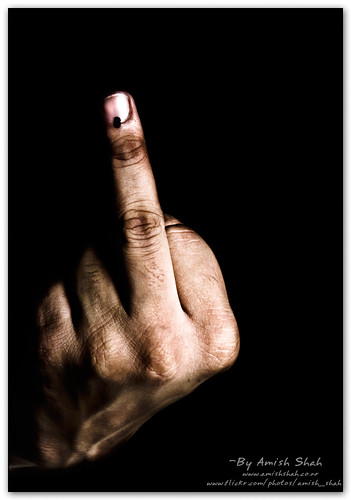
The Finger Worked
Here is a collection of sites dedicated to everything about the recently held elections in India - even folks like Yahoo had a microsite developed for users. Click Here for the results guide.Powered by ScribeFire.

Monday, May 4, 2009
Little Angels on Earth

At Rourkela, I used to go to a place called 'Home and Hope', which was on the way to my school (Saint Paul's Rourkela). I used to observe these boys and girls, (I was of their age those days: this is around fifteen years ago) and was amazed at the patience of the caretakers in looking after mentally challenged kids. I continued interacting with these folks even after school, and during my engineering, I visited a similar school at Anushaktinagar, BARC Mumbai. I was gifted a Diwali card made by a mentally challenged 11 year old - you could find more beauty and imagination in the design than any other card you have seen and you will be perplexed when you meet the kid who created it. At 'Asha Niketan' in Koramangala, Bangalore, I met a 15 year old special boy, who asked me if I liked his drawings and would like to buy some. The bigger surprise came to me later when he shared, "I like A R Rahman's music - if you buy few of my drawings, I'll get enough money to get few more of his DVDs". I was dumbfounded to hear this and was really wondering whether he is mentally challenged or the rest of the world is - how come we ignore such talents in our day to day lives of mindless hurry.
Even after I got married, I continued my visits to Ashraya, Rakum School and the Spastics Society of Karnataka in Indiranagar, Bangalore. My significant half, Pallavi, is always with me in all such visits. It has been so many years that I have been visiting such places, and still everyday teaches me something new about life, something really novel. I have had very busy schedules in life, but I have tried not to miss these visits.
At GE India, and later at Mercedes Benz India, I organized some personal visits by volunteers who want to look beyond their problems in life and look at little angles struggling to make meaning out of their existence. We also organized a tree plantation program and 'Teach me Hindi' program for the kids. It was an emotional reconnection with their school days, for many of the volunteers. At times, we organized these events personally (not through the office) so that folks from various companies can join us - we had friends from SAP, Tesco, Yahoo India, HP India, and Infosys to name a few. For us, contributing our bit was closer to heart and meant much more than just logging hours for community service on the company portal.
Life teaches you a lot of things indirectly and it depends on our observation abilities, how much we learn from it. There is a unique humility that you develop with such events and it has a great effect on your management skills. You have a much wider outlook on life. We need to realize how fortunate we are, even in our deficiencies, and how we can still make a difference to brighten someone's smile someday. :-)

Powered by ScribeFire.
Friday, May 1, 2009
Kanwal Rekhi on IT People
The guru of Silicon Valley, Kanwal Rekhi has nurtured a whole generation of tech entrepreneurs. In an exclusive interview with expressitpeople.com, the legendary venture capitalist reveals to Srikanth RP why he never mixes business with friendship“A recession is the best time to start a company.” When you hear a quote like that, you wonder if the person knows what he is talking about, as a host of technology companies have either shut shop or are on the verge of shutting down business.
But then, Kanwal Rekhi has been through every stage of the technology boom and bust cycle, and has always had a “never say die” attitude. Rekhi incidentally was laid off thrice during the initial stages of his career. But always managed to land a job soon after. His experiences however made him understand that he would not be dependent on a job forever. He started looking at companies from a business point of view rather than a technical point of view as he had done before. Even while heading a technical team, Rekhi started studying the balance sheet of different organisations. He soon migrated to a level where he could envisage the future of a company by just looking at its balance sheet. By the time he was 30, Rekhi was bored with his job profile and started looking at other opportunities.
At the same time, a small revolution was taking place in Silicon Valley and a host of promising start-ups began to emerge. Rekhi was inspired by the entrepreneurs and soon he along with two colleagues resigned from their respective jobs, and started their own company, Excelan. The idea was simple but the potential was great. During this period, IBM PCs were just being introduced and Rekhi knew that it was just a matter of time before the PCs would start getting networked. The idea of a company offering networking services was ahead of the times and soon networking became very hot. For instance, TCP/IP, the protocol on which the Internet is based, was commercialised by Excelan. The idea was great but no one was willing to fund an Indian company.
Says Rekhi, “Everyone agreed that Indians were great techies. But managerial capability was not a term you associated with them, who then were more famous as tour operators or as real estate agents.” Left with no option, the founders dug into their pockets and started funding their plans themselves. Soon destiny smiled and Excelan bagged a couple of customers. Within a short span of time, even VCs were attracted by the niche space the company was in and started providing funding. Excelan continued its upward growth and soon became the first company founded by Indians which went public on Nasdaq. Thereafter Excelan merged with Novell and Rekhi was appointed on the Board—the first time an Indian was on the Board of an international company.
Excelan’s success triggered a list of start-ups whose head honchos were Indians. Gradually, this list grew and soon the image of ‘India’ as a poverty-stricken country chan-ged. From being known as a land of snake charmers and elephants, India gradually acquired the image of a knowledge superpower highly known for its technological prowess.
His years with Excelan also showed a glimpse of Rekhi’s managerial abilities that would be more pronounced in the future. One of the three founders, the then president of the company, had no managerial capabilities. Soon the company got into trouble and the VCs fired the president. The latter expected Rekhi to leave the company with him, but Rekhi stayed on with the other founder. Rekhi was given charge of the company and made interim president till the VCs could get hold of a person who could lead the organisation. The situation was grim. Costs of personnel were rising and the company was spending more money than it was earning. Moreover, “software” was not exactly hot then, and was only seen as a small value-add to hardware.
Explains Rekhi, “Using simple mathematics, I could see that the company would close down if we did not take immediate steps. For instance, the number of engineers we had employed was much more than was required by the company. The earlier president could not take decisions in this matter and was hesitant in removing non-performing engineers. I had to take a hard decision of removing non-performers and replacing them with good people since if I did not do so, the entire company would close down eventually.” Rekhi also took a decision of revising the pricing of the product to around ten times the then current value. The decision was widely criticised by many and was seen as moving against the market tide. But Rekhi had the last laugh and the company became profitable within a span of six months. After achieving the turnaround, Rekhi was made the president of the company.
The stint at Excelan also taught him one vital thing—never mix friendship with business. Says he, “You are in trouble when you mix business with friendship because it clouds your judgement. At the end of the day, you have to have the right numbers. As the VCs always say, ‘Forget the technology. Show me the numbers.’ It is the numbers that decide the future of any business and your staying power. The rules have not changed even today.”
After his success, Rekhi concentrated his attention on scores of other fellow Indians who were in a position as he was some years ago. With some twenty other Indian entrepreneurs, Rekhi founded the Indus Entrepreneurs (TiE), an organisation which promotes entrepreneurship among young people. The organisation not only helped find entrepreneurs start-up capital but also practical guidance at various stages. TiE has funded some exceptional companies like Exodus Communications, Hotmail and Junglee.
After a host of achievements, Rekhi had nothing else to prove and by the year 1994, he was thinking that he was ready to retire as he had worked for close to 25 years nonstop. In the same year, he had an opportunity to visit IIT Bombay. He was disappointed with what he saw—the shabby badly maintained buildings. He realised that he had a responsibility towards his alma mater. Rekhi gave a $2 million grant to set up the Kanwal Rekhi School of Information Technology (Kresit), which is emerging as a small hotbed of technology start-ups in the IIT Bombay campus.
At the age of 57 years when most Indians start thinking of retirement plans and pension schemes, Rekhi today plans differently. He astounded many when he announced his decision of joining Ensim Corporation, a company in the field of providing automated Web management tools for the Web hosting industry. It is again a perfect opportunity for Rekhi to show his turnaround skills as he attempts to recharge the company on a new growth path in the current economic scenario.
Rekhi says the current scenario is similar to the days when he started his career. “It is never easy. Nothing ever happens automatically. But I certainly believe that the best time for an entrepreneur to start business is now. Getting funding may be tough, but more resources are available at lesser prices and competition is also less,” says he. Call him by any name you want–‘Legendary investor’, ‘Silicon Sage’ or just plain millionaire—Kanwal Rekhi is one man with a never say die attitude. And in times like these, you surely need more of his ilk.
Complete credits to expressitpeople.com. Click here for the original article.
Powered by ScribeFire.
Monday, April 27, 2009
A Better India, A Better World ( Narayan Murthy )
Since when was life fair! As India strides ahead in the fields of technology, entrepreneurship, and industrialism, it also is struggling with facts about undernourishment, illiteracy and disease. You have huge advancements being talked about in India, coupled with certain stark truths such as those shown in 'Slumdog Millionaire'. Life is like that. There have been constant attempts to bridge this great divide. 'A Better India, A Better World' shows us some avenues.Quoting N.R. Narayana Murthy, who pioneered, designed and executed the Global Delivery Model that has become the cornerstone of India’s success in information technology services outsourcing, shows us that a society working for the greatest welfare of the greatest number—samasta jananam sukhino bhavantu—must focus on two simple things: values and good leadership.
This book also shows the importance of an emerging India in the world, and how the progress of India is intimately linked with the progress of the rest of the world as well. To quote the book, "A better India holds the key to a better world."
While talking with Shishi Bhate, Murthy says, "Every nation from time to time will face difficulties in the economic scenario and that is the time when we all have to show greater determination, sacrifice, and commitment."
Based on lectures delivered around the globe, the book makes a great reading and is specially relevant for the youth.
Click here to buy yourself a copy. (No affiliation of the author with this seller.)

Wednesday, February 4, 2009
Indian VCs
You start the stuff on your own and keep up your spirits till you reach a huge pit. This pit is the point at which you have to prove that your startup has power, by overcoming and jumping to the other side. This is the place at which you will be needing the most help, particularly in the financial part. When you search for a VC, he will be smiling at the other side of the pit! He'd say, Show me 'that your Idea works for one customer' and I will lead it to success! In his words, this means, jump over this pit in front of you and I have a limo waiting on the other side to take to to our goal. In what way are these 'early stage' VCs? They are not ready to put money in un-tested ideas and just 'me too' approach can not take us real ahead.
If you are an original thinker, better save some money and get your friends together to help you out as VCs here seem to be not ready to wet their feet! Any thoughts?!
All rights reserved for site content.
Visit Jeev's Homepage
Monday, January 26, 2009
Re-public Vote
I seriously do not understand the voting system in India where you cannot vote if you are a resident of a city other than where you got your voter's card. Like a driving license, I should have the ability to vote in any city that I reside in if I satisfy the other criteria that allow me to vote. I know we have gaps in this proposition - but isn't it high time that a IT driven country uses IT to eliminate the gaps in implementing the above requirement. The call is a long one, but I want to contribute my two-paise thoughts in to this. I have a I-card like my PAN card or a driving license and I am qualified to vote in Bangalore - I walk to the voting center and register my vote for the required election. If I vote at one place for the same election, I cannot vote once more. But if I want, I should be allowed to vote in my native place for the lok sabha elections as well. We can sit together to formulate how things should be. This will help me if I am unable to travel to my native (or wherever I have the voter card issued), to still vote. It is really important that the educated India votes. Any thoughts?
All rights reserved for site content.
Visit Jeev's Homepage
Share This Site
Please use the Share/Bookmark/Tell-a-friend Icons after each post to connect to your favorite bookmarking sites or email the post to a friend.