Thursday, May 7, 2009

The Economic Problem Mind Map

A mind-map approach to the Economic Problem. Please visit the parent page here.


Powered by ScribeFire.


Tuesday, May 5, 2009

Subways and Coconuts

Long back, at the IIT Bombay campus, I saw a guy whose T-shirt had a monk in the front side and a caption at the back that said "it's all about control! - syscon iitb". (Syscon refers to the department of Systems and Controls at IITB.)  Recently, when I read about the book, 'Dance with Chance: Making Luck Work For You', it was a mixture of technical and non-technical thoughts that flowed through my mind. Insead Knowledge reviewed the book here, with a title that said 'The illusion of control: dancing with chance'. Well, is it really 'control' and is it really an 'illusion' that we are speaking about? Let me explain my last statement...

Certainty and uncertainty have been at the forefront of many ideas. Predictions with analysis always has been an interesting topic in a variety of fields. And the book mentioned above emphasizes that while we do have to live with unanticipated situations, we can always reduce the risks involved with proper analysis and decisions. What is an unanticipated situation? Something which was not visible to the observers in the initial stages(?). It might be due to lack of data or due to change in the nature of current data.  It might also be due to incorrect assumptions in the analysis. So, the prediction of such situations is basically a process to find out the probability of correctness of the data, the assumptions, and the process of analysis. (This later forms the basis of later assumptions and analysis - so, an error in the previous analysis may get carried forward.)

The topic of Subways and Coconuts is mentioned because of the difference in  the probabilities of correctness in predicting events related to them. You can do research and be relatively sure that the subway will be predictable most of the time. On the other hand, you know that coconuts fall from trees, but you can’t predict when they will fall or where they will land. So, you can plan for the subways, but it is difficult to plan for the coconuts. Although for the common man, it is really true, but if you are analyzing the falling of coconuts, you can still predict their falling by looking at the wind speed, the stage of growth of the coconut, and some other factors that we generally ignore or which are generally not as visible as the variables around a subway. (This point is slightly missed out by the authors.) So, the secret to predicting the falling of a coconut is to look at more variables that can impact your experience (of being hit by a falling coconut) that are not as visible but as important. (How many times do we think of wind speed when we are trying to predict the falling of a coconut?) All uncertainties and the associated illusions can be predicted to expected or near-expected levels of accuracy - they do not really remain uncertainties nor illusions then! Read on below..


Could we have predicted the economic slowdown then? Yes if we had all the variables and parameters with us - which is not always the case. There are many parameters and variables we should have (could have) looked into. Since it is not possible to look into all of them, we really need to focus on things where we have larger control and manoeuvre things so that the ones which we cannot predict have a lesser impact on the overall aim of our analysis. Financial domain is some place where all the variables may not get defined with the appropriate weights in the beginning.

I appreciate the efforts of the authors to put a complicated topic in a simpler manner, and show how risk management forms an integral part of the daily life of the common human. They have also pointed out the importance of accepting the fact that there are things beyond our control (we will never have all the variables). The book is authored by Spyros Makridakis, Robin Hogarth and Anil Gaba. To quote the Insead review:

First you accept that there are things you can’t control. Then you try to assess the uncertainty and finally augment your plan to make sure you manage risk more effectively.

That means using models, independent opinions, internal and external advice and any other means to assess the unknown risks and to make your business nimble and open to change when the unexpected happens.

“You are better off focusing your energy on planning for the range of possibilities that could actually happen,” Gaba says.

For example, he says it’s very difficult to tell which start-up businesses will be successful in the early stages. If you accept that, a better strategy is to try to diversify over a number of projects just as venture capitalists do. Not all the projects will pay off but you diversify your risk so that you have a better chance of nurturing one that will succeed.

By all means, a very good book to mentally and technically prepare you to manage risk in a more calculated (or prepared) manner than now. It covers a variety of domains and gives you tools to handle uncertainties in life, and particularly in business. Deal with chance or rather dance with it!


Powered by ScribeFire.

Monday, May 4, 2009

Little Angels on Earth

Two and a half years have passed by since I was first in the campus of Ashraya and even now, when I go there every week, it seems to be a new experience. As I walked to the campus yesterday, I was wondering how quickly time moves. It was not the first time that I was in such a place but it was a very special experience to be with kids around you who are not just special but very talented as well. During the initial days, I was with a GE Volunteers team and had volunteered to teach these kids, mathematics, origami, and lots of fun-making activities. Most of the kids at Ashraya are normal from a physical point of view, but not so from the emotional point of view - I would term them para-normal! They are a bit more mature than their age, which varied between 3 to 13 years. Ashraya has a number of infant orphans as well but we were not interacting with them. This place was unlike the Helen Keller Institute at Vashi, Mumbai where was dealing with special kids with visual and hearing challenges. You need a different level of patience while interacting with these little angels.
                                                       

They have a garden with swings, slides and see-saws to play with. I used to hold them in my arms and rotate fast - they enjoyed these rides and you should just see the expression on their faces. We were not supposed to take photographs, but over the years, I have taken snaps of the work done by the kids, such as in their coloring books. Last year, for Christmas, I got an idea which was quickly accepted by the other team members - we gifted them gifts which we helped them to make. Let me explain that a bit: We taught them how to make Santa Claus masks, cone caps with bells, and paper toys. Then few of them became Santa and all of them played a game where you have to sing for Santa and get your gifts! There were many sessions when we showed them animated movies - they loved Ice Age 2! They loved Winnie the Pooh so much that it took them no time to learn when I taught them how to draw and later paint, huge Winnie posters.


We have Rakum school for the blind at Indiranagar, Bangalore where I live. This is another place which I frequently visit since I have been in Bangalore. Initially, many of my visits were anonymous, and I felt good that I am able to contribute to the education of such special kids - they needed our time and understanding more than monetary contributions. As per Mr Rakum, there are many folks who contribute money, but the number of persons who contribtue their time is very less. It is a different kind of realization and an expansion of the awareness of your existence, when you are with these kids.

At Rourkela, I used to go to a place called 'Home and Hope', which was on the way to my school (Saint Paul's Rourkela). I used to observe these boys and girls, (I was of their age those days: this is around fifteen years ago) and was amazed at the patience of the caretakers in looking after mentally challenged kids. I continued interacting with these folks even after school, and during my engineering, I visited a similar school at Anushaktinagar, BARC Mumbai. I was gifted a Diwali card made by a mentally challenged 11 year old - you could find more beauty and imagination in the design than any other card you have seen and you will be perplexed when you meet the kid who created it. At 'Asha Niketan' in Koramangala, Bangalore, I met a 15 year old special boy, who asked me if I liked his drawings and would like to buy some. The bigger surprise came to me later when he shared, "I like A R Rahman's music - if you buy few of my drawings, I'll get enough money to get few more of his DVDs". I was dumbfounded to hear this and was really wondering whether he is mentally challenged or the rest of the world is - how come we ignore such talents in our day to day lives of mindless hurry.


Even after I got married, I continued my visits to Ashraya, Rakum School and the Spastics Society of Karnataka in Indiranagar, Bangalore. My significant half, Pallavi, is always with me in all such visits. It has been so many years that I have been visiting such places, and still everyday teaches me something new about life, something really novel. I have had very busy schedules in life, but I have tried not to miss these visits.

At GE India, and later at Mercedes Benz India, I organized some personal visits by volunteers who want to look beyond their problems in life and look at little angles struggling to make meaning out of their existence. We also organized a tree plantation program and 'Teach me Hindi' program for the kids. It was an emotional reconnection with their school days, for many of the volunteers. At times, we organized these events personally (not through the office) so that folks from various companies can join us - we had friends from SAP, Tesco, Yahoo India, HP India, and Infosys to name a few. For us, contributing our bit was closer to heart and meant much more than just logging hours
for community service on the company portal.

Life teaches you a lot of things indirectly and it depends on our observation abilities, how much we learn from it. There is a unique humility that you develop with such events and it has a great effect on
your management skills. You have a much wider outlook on life. We need to realize how fortunate we are, even in our deficiencies, and how we can still make a difference to brighten someone's smile someday. :-)


Powered by ScribeFire.

Friday, May 1, 2009

Kanwal Rekhi on IT People

Complete credits to expressitpeople.com. Click here for the original article.

The guru of Silicon Valley, Kanwal Rekhi has nurtured a whole generation of tech entrepreneurs. In an exclusive interview with expressitpeople.com, the legendary venture capitalist reveals to Srikanth RP why he never mixes business with friendship

“A recession is the best time to start a company.” When you hear a quote like that, you wonder if the person knows what he is talking about, as a host of technology companies have either shut shop or are on the verge of shutting down business.

But then, Kanwal Rekhi has been through every stage of the technology boom and bust cycle, and has always had a “never say die” attitude. Rekhi incidentally was laid off thrice during the initial stages of his career. But always managed to land a job soon after. His experiences however made him understand that he would not be dependent on a job forever. He started looking at companies from a business point of view rather than a technical point of view as he had done before. Even while heading a technical team, Rekhi started studying the balance sheet of different organisations. He soon migrated to a level where he could envisage the future of a company by just looking at its balance sheet. By the time he was 30, Rekhi was bored with his job profile and started looking at other opportunities.

At the same time, a small revolution was taking place in Silicon Valley and a host of promising start-ups began to emerge. Rekhi was inspired by the entrepreneurs and soon he along with two colleagues resigned from their respective jobs, and started their own company, Excelan. The idea was simple but the potential was great. During this period, IBM PCs were just being introduced and Rekhi knew that it was just a matter of time before the PCs would start getting networked. The idea of a company offering networking services was ahead of the times and soon networking became very hot. For instance, TCP/IP, the protocol on which the Internet is based, was commercialised by Excelan. The idea was great but no one was willing to fund an Indian company.

Says Rekhi, “Everyone agreed that Indians were great techies. But managerial capability was not a term you associated with them, who then were more famous as tour operators or as real estate agents.” Left with no option, the founders dug into their pockets and started funding their plans themselves. Soon destiny smiled and Excelan bagged a couple of customers. Within a short span of time, even VCs were attracted by the niche space the company was in and started providing funding. Excelan continued its upward growth and soon became the first company founded by Indians which went public on Nasdaq. Thereafter Excelan merged with Novell and Rekhi was appointed on the Board—the first time an Indian was on the Board of an international company.

Excelan’s success triggered a list of start-ups whose head honchos were Indians. Gradually, this list grew and soon the image of ‘India’ as a poverty-stricken country chan-ged. From being known as a land of snake charmers and elephants, India gradually acquired the image of a knowledge superpower highly known for its technological prowess.

His years with Excelan also showed a glimpse of Rekhi’s managerial abilities that would be more pronounced in the future. One of the three founders, the then president of the company, had no managerial capabilities. Soon the company got into trouble and the VCs fired the president. The latter expected Rekhi to leave the company with him, but Rekhi stayed on with the other founder. Rekhi was given charge of the company and made interim president till the VCs could get hold of a person who could lead the organisation. The situation was grim. Costs of personnel were rising and the company was spending more money than it was earning. Moreover, “software” was not exactly hot then, and was only seen as a small value-add to hardware.

Explains Rekhi, “Using simple mathematics, I could see that the company would close down if we did not take immediate steps. For instance, the number of engineers we had employed was much more than was required by the company. The earlier president could not take decisions in this matter and was hesitant in removing non-performing engineers. I had to take a hard decision of removing non-performers and replacing them with good people since if I did not do so, the entire company would close down eventually.” Rekhi also took a decision of revising the pricing of the product to around ten times the then current value. The decision was widely criticised by many and was seen as moving against the market tide. But Rekhi had the last laugh and the company became profitable within a span of six months. After achieving the turnaround, Rekhi was made the president of the company.

The stint at Excelan also taught him one vital thing—never mix friendship with business. Says he, “You are in trouble when you mix business with friendship because it clouds your judgement. At the end of the day, you have to have the right numbers. As the VCs always say, ‘Forget the technology. Show me the numbers.’ It is the numbers that decide the future of any business and your staying power. The rules have not changed even today.”

After his success, Rekhi concentrated his attention on scores of other fellow Indians who were in a position as he was some years ago. With some twenty other Indian entrepreneurs, Rekhi founded the Indus Entrepreneurs (TiE), an organisation which promotes entrepreneurship among young people. The organisation not only helped find entrepreneurs start-up capital but also practical guidance at various stages. TiE has funded some exceptional companies like Exodus Communications, Hotmail and Junglee.

After a host of achievements, Rekhi had nothing else to prove and by the year 1994, he was thinking that he was ready to retire as he had worked for close to 25 years nonstop. In the same year, he had an opportunity to visit IIT Bombay. He was disappointed with what he saw—the shabby badly maintained buildings. He realised that he had a responsibility towards his alma mater. Rekhi gave a $2 million grant to set up the Kanwal Rekhi School of Information Technology (Kresit), which is emerging as a small hotbed of technology start-ups in the IIT Bombay campus.

At the age of 57 years when most Indians start thinking of retirement plans and pension schemes, Rekhi today plans differently. He astounded many when he announced his decision of joining Ensim Corporation, a company in the field of providing automated Web management tools for the Web hosting industry. It is again a perfect opportunity for Rekhi to show his turnaround skills as he attempts to recharge the company on a new growth path in the current economic scenario.

Rekhi says the current scenario is similar to the days when he started his career. “It is never easy. Nothing ever happens automatically. But I certainly believe that the best time for an entrepreneur to start business is now. Getting funding may be tough, but more resources are available at lesser prices and competition is also less,” says he. Call him by any name you want–‘Legendary investor’, ‘Silicon Sage’ or just plain millionaire—Kanwal Rekhi is one man with a never say die attitude. And in times like these, you surely need more of his ilk.

Complete credits to expressitpeople.com. Click here for the original article.


Powered by ScribeFire.

Thursday, April 30, 2009

H6 G-Sec

What do you do when your team member has done a blunder and you are forced to defend him? Or when you have to handle an unofficial beer party with official guests?

From the middle of the third year of engineering to that of the fourth year, it was a mix of many such experiences when I was the General Secretary of my hostel. Before I got elected as the General Secretary (G-Sec, as they say) I had no idea that I would be contesting for such a post ever in my life. H6 expands to 'Hall of Residence 6'. At NIT Rourkela, you had six 'Halls of Residence' for men and two for the ladies. (NIT stands for National Institute of Technology. There are around 17 such universities in India.)

I had my own share of friends and enemies during my college days. But I had this habit of being in touch, and knowing details about almost everybody on the campus, including the smaller folks like security guards or the cafeteria staff. Sanjay Dutt's Kaante was released the year before we stood for election. I remember the room-to-room campaigning, printing posters with catchy phrases, raising slogans in front of the university on improvement issues, late night partying, answering people through text messages during lecture hours, and still maintaining some level of performance in the academics - I do not know how it all fitted together. We used to sing 'Jaane kya hoga raama re' on the building corridoors in the middle of the nights! We were four folks who sat together to make a strategy that no one could break - we all were elected to the board of management of the hostel. We had a cultural secretary, a sports secretary, a kitchen secretary and myself as the general secretary. As for me, there was just one more candidate who stood against me in the election - we had a good handshake once I was announced as selected.

Life changed in many ways. We used a number of discussions, both public as well as within our group, to formulate plans for improvements in H6. After years, we were most punctual in organizing the 'Independence Day' celebrations. We organized groups discussions for folks who were preparing for MBA entrance exams. There were a lot of enthusiasm generated for team outings - it was fun to handle everything from logistics to entertainment to feedback.

Being a G-Sec exposed me to newer arenas. I was able to look at the working of an education institution and a residential building with around 200 inmates. I saw the various rules made ages ago and work to revamp them with more relevant ones. There was change all around in the air. There was a change in the menu of the cafeteria, and we put a feedback system in place for folks. There was a change in the visitors policy as well, and for the first time, we had female students visit the hostel - this was banned earlier due to some archaic laws. This change was motivated by what the public felt about themselves being mature students of an university which ranked third amongst all the NITs in India and stood first for branch-specific rankings.

There was also a change in the inmate categories in the hostel - let me explain that a bit. We had residents in H6 who mostly comprised of MCA and lateral entry students. MCA stands for Master in Computer Applications and the lateral entry students were the ones who joined in the second year of engineering after completing their technical diplomas. Apart from this, we had a number of students who were 'back logged', that is they could not complete a year's course in the given time. Unlike the other hostels, there was a lack of a proper mix of students from all branches and streams in the university. This was changed when we were in. We brought in an exchange between the inmates of the various hostels and ensured that the student profile was diversified and that we had more interaction amongst students of all streams.

The cafeteria menu included 'Pakhaala' for the first time in the history of the institute. Pakhaala is a special food made in Orissa during summers - it is made by soaking boiled rice in water, and adding salt and spices. NITs have students from all over India and this was an experience that all students from outside of the state of Orissa had for the first time in their lives, and they did love it during the scorching heat of the summers.

Almost every other day of our tenure, we had some issue flare up - it was not all that peaceful. As I mentioned in the very first sentence of this write-up, there was a quarrel between one of my team mates, the kitchen secretary and one of the cooks. The food was pathetic that day and the fellow ended up getting pinned against the wall and receiving boxing shots from the students. I had to interfere in between to stop this hungama and within few minutes, someone had informed the hostel warden. While I was trying to settle things in the kitchen itself, my mobile rang with the warden on the call.

One hour of drama and then a short-lived peace - the warden took stock of the situation and put a show-cause notice to the student, asking why he should not expel him. Being expelled meant that he will lose all of his engineering career and has to start over again - something he had not thought before hitting the cook. It also meant that there will be a police record of the situation, which meant a big blur on his career graph. I could not support him for what he did and could not let the warden ruin his career as well. It was a heated discussion for two hours after which he was pardoned on the condition that he will do social work for the university and never repeat such an act. (There were a string of clauses before he was let off, including public apology to the cook.) I also advised that the cook be shifted to the adjoining hostel and replaced by the other cook there.

Another time there was a public outcry when one of the inmates hit a girl on the road while riding a bike, and both of them were in the intensive care unit of the largest hospital in the city. It was a mad crowd at the hospital gates, with people shouting slogans against the students. Well, we handled it properly, with adequate medical attention to both the patients and adequate attention to the public as well. My friends helped me a lot when I was standing in front of the mob - I just didn't want to be 'mobbed' by them!

One new thing I understood was the profile of poor students on government scholarships - my signature was required before waiving of their hostel fees and I could understand the amount of struggle these folks put in to come from stark poverty and going to become future technocrats of the world. One of such persons is still in contact with me even after six years of these events and I know he works for one of the biggest MNCs of the globe. Being in NIT, where students from all states of India are proporta

My daily work also involved coordinating with the hostel staff, security fellows, maintenance guys, contractors and suppliers. It showed the aspects of society where bribing was a way of life and I was not at all for it. It also allowed me to educate such people on how they could leverage themselves without resorting to under-the-table methods. One of the best lessons I learned was about 'when to kiss and when to kick' people. There were, at times, trade offs between what I thought and what others thought.

This way, acceptability is another thing that I learned as a G-Sec. It is not always that your ideas get accepted, but if you believe in the idea, you should know how to put it forth. As they say in Deutsch 'Der Tone macht der Musik' - it is the tone that makes the music. Another part of acceptability is to be aware and agree to others' perspectives. Seriously there's some art to it.

Each of the lessons learned during this stint was helpful in some or the other aspect of my professional life later. I could relate a lot of the characteristics of human behavior that I had observed those days, to those of my colleagues and managers. It also instilled in me, an approach to look at the bigger picture during any decision making. Managing people and their attitude is an art. It also reduces the amount of unnecessary frustration that many freshers have, at their workplace. Multi-tasking and emotion management are amongst more more things that I learned. Till date, I have organized five team outings for my colleagues at various companies and each of them has been a memorable one. Life teaches.. !

It was a mix of good and learning stuff those days - During a Governing Body meeting, I remember talking with the warden of the ladies hostel when he mentioned a funny incident: There was this girl who left the ladies' hostel mentioning that she's going to the library, and the warden spotted her kissing her boyfriend under some tree. The warden scribbled on the security logbook, right next to the entry made by the girl '..... was found in 'love' and not in the library'!


Powered by ScribeFire.

Tuesday, April 28, 2009

Lost your job?


Its just the way it was in the saying, 'A successful man is one who can lay a firm foundation out of the bricks thrown at him'. There are many who are putting on an entrepreneurial cloak  and have started to sell lay-off merchandise. There have been many a case these days where people have been called for interviews after someone saw a 'Laid Off Need a Job' wristband or a 'jobless-tagged-T-shirt'. There are games that have come up like 'Search a Job'! Have a look at jobsearchagameoffrustration.com.

Humor, they say, is a great medicine and making people laugh at themselves is helping some new businesses break even in just a few months time. Daniel Brabson, 38, launched RecessionJunction.com. The site sells beer mugs, T-shirts and bumper stickers with humorous sayings about the economy and layoffs. Bestsellers include a pint glass that says "This Beer is Going Down Like the Stock Market."

I am not sure how long this can continue giving profits, but it sure is a profitable way of making a living in these slow times. In any case, they do provide a small laughter to many and make them forget their woes for a short while. And its cool if such a T-shirt really helped you get noticed and grab a job back! (In addition to making the T-shirt seller, richer by a few bucks.)


Monday, April 27, 2009

The Dancing Lady

"Hi!!!"

The loud chorus of children was sharp, as they got down from their bus. And the colors were beautiful. I like blue.

It was a cool morning and I just came out of the college building where I had been to appear for a national examination. The exam went well, and after that, I was delighted to see so many children.

The group that got down from the bus comprised mostly of girls. They must in the age group of 12-16 years, accompanied by a couple of teachers. They had come here to participate in a group dance performance.

They went in a queue, led by a well-dressed man. I asked the security guard nearby whether I could attend the children's show. He said it is a public show and that too a free one. People were welcome to donate if the willed too.

I went ahead and lodged myself in a right corner seat in the front row. The advantage in a corner seat in the front row is that you can see who is coming next on stage before others can know.

I was struck by one particular girl. Of course, she was the reason I thought of staying back and watching the show. There are three things I would like to tell you about this girl.

Firstly, she had a amazing personality. The way she carried herself, the way she talked to other friends, the way she listened and followed the teacher who was accompanying them was really something. She had a wonderful calm around her, and seemed to exude a great sense of confidence.

Secondly, the dance that she did after some time on stage was enthralling. It was a "Geeti-Natya", a song-drama, that was played in the form of a dance. The theme was about helping each other in order to have better results for the nation, and the world.

Forget about the theme, my eyes were hooked on the girl I spoke of. She must be sixteen. She was wearing a blue dress, with snow-white wings on her arms as she was enacting an angel. It so much suited her character! She had a white veil on her hair. It was amazing. Simply amazing. She danced with amazing gait and seemed to carry the whole show herself.

It was a half-an hour performance, but it did not seem so. The received a standing ovation after the performance.

The third thing that I wanted to mention about this girl was that, like all her group members in the dance, she was blind.

I cannot imagine the sharpness of the brain behind the little child's imagination, and the amount of hard-work that she must have done to achieve the perfection that she showed on stage. Her mobility was awesome.

Try doing a simple experiment. In your own house, just close your eyes and try dancing. You can try this when no one is at home so that people do not laugh at you, but it would be a good idea to have some friend nearby so that you don't hurt yourself by falling down. Dance as a blind and think how easy or difficult the act is.


Life is a surprising experience. A amazing tale of conviction and faith winning the last bites of misfortune and sorrow. Life is beautiful.

I was too speechless, over-awed, and choked by emotions to do anything but just keep looking. After the show, I talked to the teacher who accompanied them. I informed about my efforts at making a shoe-fitted navigation device for visually-impaired persons. And I informed about one of the members of National Blind Association with whom I have been in touch in order to make my product a better one. I asked him if I could talk to the girl that I mentioned.

Sadhana. I do not have a perfect English equivalent of the word that represented her and her name so aptly. Literally, Sadhana means penance. But it is much more.

I talked to her. I told her about a small chip that can be fitted in her shoes and that will guide her if their is any obstacle in her path. It may also learn specific dance steps and guide her to dance better.

"Bhaiya! Even without your chip, I can dance like anything!" was her innocent reply. "But please tell me for sure when the thing is ready. Do you have something I can put in my eyes so that I can see your face?"

She had her arms around me. And one of the 'bestest' smiles I have ever seen in my life.


A Better India, A Better World ( Narayan Murthy )

Since when was life fair! As India strides ahead in the fields of technology, entrepreneurship, and industrialism, it also is struggling with facts about undernourishment, illiteracy and disease. You have huge advancements being talked about in India, coupled with certain stark truths such as those shown in 'Slumdog Millionaire'. Life is like that. There have been constant attempts to bridge this great divide. 'A Better India, A Better World' shows us some avenues.

Quoting N.R. Narayana Murthy, who pioneered, designed and executed the Global Delivery Model that has become the cornerstone of India’s success in information technology services outsourcing, shows us that a society working for the greatest welfare of the greatest number—samasta jananam sukhino bhavantu—must focus on two simple things: values and good leadership.

This book also shows the importance of an emerging India in the world, and how the progress of India is intimately linked with the progress of the rest of the world as well. To quote the book, "A better India holds the key to a better world."

While talking with Shishi Bhate, Murthy says, "Every nation from time to time will face difficulties in the economic scenario and that is the time when we all have to show greater determination, sacrifice, and commitment."

Based on lectures delivered around the globe, the book makes a great reading and is specially relevant for the youth.

Click here to buy yourself a copy. (No affiliation of the author with this seller.)


Thursday, April 23, 2009

Business as a Social Solution

Half of the world's pain is due to lack of money and the other half is due to excess of it, they say. I would not agree with this completely, though there is a lot of truth in it. I have always thought of business as a very good means of solving social problems. Whether it be related to health-care or education, a business oriented approach will prove more efficient than charitable solutions. In fact, it is generally observed that charitable efforts are the most inefficient in solving situations. There is a saying that goes like, "If you give a man a fish, you feed him for the day. If you teach him fishing, you feed him for life". Charitable means of educating people or making them capable of solving their own needs have never been really successful. But when you make a business-like approach, keeping in mind a win-win situation, things have shown improvements.

By being business-like, I do not mean to be entirely money oriented. What I mean to say is to show to everyone who receives help, that there is nothing like a free lunch. Charging some money for a service makes it more worthwhile for the recipient of the service.

If you take the example of efforts by the government to provide free/subsidized food to people below poverty line, it has only led to the increase in forgery in making the infamous BPL card (People with a BPL card are officially Below Poverty Line.) Is this the ultimate solution to help the poor get better food? I do not think so. People in slums who were given free houses by the government, let those houses on rent and made a new slum a little distance away. What was the problem that got solved? Wasn't a more business-like approach (than distributing free houses) feasible? Makes your mind tick...

The ideas of folks like Muhammad Yunus also reflect some new thoughts. We are not talking of a  business that saps the poor but it does show the difference money (in however small amount) can make.

To quote Dr Yunus,
Suppose we postulate a world with two kinds of people, having different objectives. One type is the existing type, i.e. profit maximizing type. Second type is a new type, who are not interested in profit-maximization. They are totally committed to make a difference to the world. They are social-objective driven. They want to give better chance in life to other people. They want to achieve their objective through creating/supporting sustainable business enterprises. Their businesses may or may not earn profit, but like any other businesses they must not incur losses. They create a new class of business which we may describe as "non-loss" business.

Similarly, have a look at efforts by John Wood for 'Room to Read' at http://www.leavingmicrosoftbook.com/ . Room to Read partners with local communities throughout the developing world to provide quality educational opportunities by establishing libraries, creating local language children's literature, constructing schools, and providing education to girls.
Suzlon solves the energy needs of millions of people using wind energy. And it is a 'for profit' venture. How is it different from what we discussed just now? Doesn't Tata solve the common man's problem from salt to steel? And Tata still believes in doing more for the individual as well as the corporation.

What about the aim of Infosys founder NR Narayanmurthy - he refers to corporate socialism as 'a problem solver' and the Infosys foundation under Sudha Murthy is dedicated to such efforts.

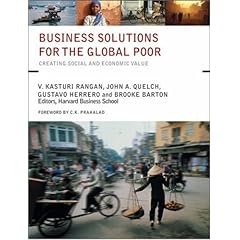
Have a look at the book "Business Solutions for the Global Poor: Creating Social and Economic Value", by V. Kasturi Rangan, John A. Quelch, Gustavo Herrero, and Brooke Barton . The work combines chapters from an assortment of views—business, academic, government, nonprofit—to examine the nature of poverty, how the poor can become producers as well as consumers, and the roles/responsibilities to be played by policymakers and society at large. Of particular interest to business leaders are a number of case studies of successful BOP (Bottom of economic Pyramid) business models.

My point is that in addition to conventional business ideas that do contribute to solving social situations, there a need for (and it is happening these days) folks who are dedicated 'Social Entrepreneurs'. We can use entrepreneurial principles to organize, create, and manage a venture to make social progress. (I mentioned 'progress' - not just 'change'). It is not a loss making idea but a "more-than-profit" idea, because the metrics for measuring success are not just the monetary part but the social impact it has created.

I feel this can make this world a far better place, without distorting the true fact that there is never a free lunch.


Powered by ScribeFire.

Share This Site

Please use the Share/Bookmark/Tell-a-friend Icons after each post to connect to your favorite bookmarking sites or email the post to a friend.
